

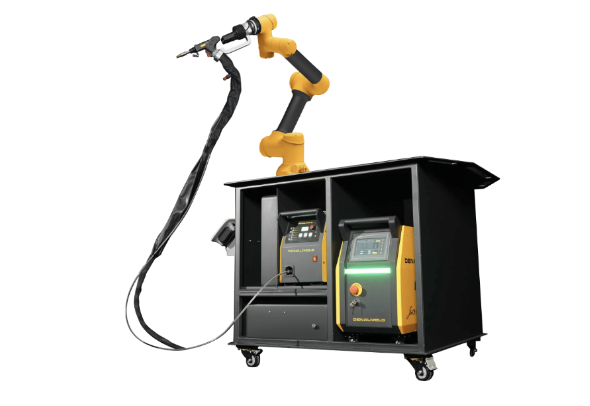
As manufacturers face rising production demands, tighter delivery schedules, and ongoing skilled labor shortages, many are rethinking how automation fits into their welding operations. Traditional robotic welding has been the industry standard for decades, offering high-speed performance and consistent welds in large-scale environments. But with the rise of more flexible, user-friendly automation, cobot welding performed using collaborative robots has quickly gained traction.
Unlike conventional robotic systems, cobots are designed to work safely alongside human operators, requiring less space, less complexity, and far lower integration costs. The shift has many businesses asking: What exactly sets cobot welding apart? And how do you know which option better suits your workflow? This article breaks down the major differences so you can evaluate which automation path aligns with your productivity goals, budget, and long-term capabilities.
Why Manufacturers Are Reevaluating Welding Automation
Before exploring how cobot welding differs from traditional robotic welding, it helps to understand the core challenges driving automation adoption:
- Shortage of skilled welders, making it difficult to maintain consistent quality
- High product variation, which traditional robots don’t always handle efficiently
- Pressure to reduce labor-intensive tasks and improve throughput
- Inconsistent weld quality across different human operators
Cobot welding offers a flexible alternative, particularly for shops with tight budgets or high-mix production environments.
Flexibility and Ease of Deployment
Traditional robotic welding requires structured environments dedicated cages, fixed tooling, and specialized programming. In contrast, cobot welding excels in smaller or shifting production setups.
Why cobots are more flexible
- Easy repositioning: Cobots can be moved between workstations without major reconfiguration.
- Simple programming: Most cobots support “teach by hand” guidance, eliminating the need for specialist programmers.
- Ideal for high-mix, low-volume production: Cobots perform well when part styles and quantities vary frequently.
- Smaller footprint: No need for large safety cages or isolation zones in many applications.
Traditional robots remain better suited for large, repeatable jobs but cobots shine when agility is required.
Safety Differences Between Cobots and Traditional Robots
Traditional industrial robots operate at high speeds and typically require fenced-off areas with interlocked safety systems. They assume no human will enter their workspace.
Cobot Safety Advantages
- Built-in force sensors: These stop the cobot when unexpected contact occurs.
- Reduced-speed modes: Cobots automatically adjust speed when operators are nearby.
- Collaborative-rated hardware: Edges, joints, and arms are engineered for safe shared use.
Traditional Robot Safety Requirements
- Safety cages
- Light curtains or scanners
- Emergency stop architecture
- Strict operator training
While cobots simplify safety integration, laser welding may still require shielding, PPE, and safe access zones regardless of robot type.
Precision and Speed: Where Each System Excels
The performance gap between cobots and traditional robots depends largely on production scale and part complexity.
Traditional Robotic Welding Strengths
- Extremely fast cycle times
- Designed for continuous 24/7 production
- Ultra-high repeatability for mass manufacturing
Cobot Welding Strengths
- Excellent precision for small to medium welds
- Repeatability suitable for most fabrication shops
- Slower but more adaptable than classic robots
Cobots typically weld slower than industrial robots due to safety limitations, but they provide more than enough speed for small to medium run volumes.
Cost Differences: Upfront and Operational
Cost is one of the biggest factors influencing automation decisions.
Cobot Welding Cost Benefits
- Lower purchase price compared to traditional robots
- Faster integration, often requiring no custom programming
- Reduced training costs due to intuitive interface
- No expensive guarding or extensive facility modifications
Traditional Robotic Welding Costs
- Higher upfront hardware investment
- More complex integration
- Ongoing maintenance handled by specialists
ROI Consideration
For many small and mid-size manufacturers, cobot welding provides a significantly faster return on investment often within 12–24 months, depending on part volume and labor savings.
Programming and Usability
One of the biggest differences between cobot welding and traditional robotic welding is how operators interact with the system.
Cobot Usability Advantages
- Hand-guided teaching
- Drag-and-drop interface
- Less reliance on coding
- Quick changeovers between part types
Traditional Robot Programming Challenges
- Steeper learning curve
- Often requires trained robot programmers
- Time-consuming adjustments when switching between product types
This difference makes cobots especially suitable for shops with limited automation experience.
Accuracy and Weld Quality Based on Use Case
Laser, MIG, TIG, and hybrid welding can all be integrated with both cobot and traditional robotic systems, but the results depend heavily on your workflow.
Where Cobots Excel
- Precision welding on small components
- Thin materials requiring careful heat control
- Medium-volume production
- Operations needing operator interaction (e.g., tack welds, repositioning)
Where Traditional Robots Excel
- High-volume, high-speed production
- Thick steel parts requiring continuous welds
- Repetitive weld paths with no variation
Both systems can deliver excellent weld quality when implemented with proper fixturing, programming, and material preparation.
Comparison Table: Cobot Welding vs. Traditional Robotic Welding
| Category | Cobot Welding | Traditional Robotic Welding |
| Flexibility | High | Low |
| Speed | Moderate | High |
| Programming Difficulty | Low | High |
| Safety Requirements | Low–Moderate | High |
| Cost | Lower | Higher |
| Ideal Use Case | High-mix, low-volume | High-volume, repeatable |
| Footprint | Small | Large |
| Operator Interaction | Moderate | Minimal |
If you’re evaluating whether cobot welding aligns with your production goals, exploring equipment that supports precision and modern automated workflows is a great place to start. Brands like Denaliweld offer tools and systems designed for advanced welding environments and collaborative automation setups.
Conclusion
Cobot welding and traditional robotic welding each play important roles in modern manufacturing but they serve different needs. Traditional robotic welding remains unmatched for high-volume, long-run production where speed and repetition are essential. Meanwhile, cobot welding provides a flexible, accessible, and cost-efficient alternative for small to mid-size operations or manufacturers who frequently change part designs.
By understanding the differences in safety, speed, programming, cost, and flexibility, you can better determine which system aligns with your workflow. Whether your goal is to increase output, reduce dependency on manual labor, or improve weld consistency, both automation paths offer clear benefits. The key is choosing the solution that provides the greatest long-term value for your specific production environment.

