

How to Spot a Fake The Row Bag
Verifying a bag from this label is unlike authenticating any other luxury handbag, and the explanation takes one line. There is simply no code to look up. Because no public serial number, no date code and no authenticity card exist, every familiar shortcut is off the table. The substitute is material and construction literacy: knowing what correct stitching, edge paint, hardware and leather feel like. Reading a number would be easier, but this is the more reliable route, since counterfeits as of 2024 and 2025 are widely reported to pass photograph inspection. What follows are seven checks, sequenced the way a practised buyer approaches a row bag in hand — the simplest first and the hardest at the end.
What You Will Never Look Up
Most buyers go wrong here, which is why it earns its own section. A seller who offers a serial number, date code, registration reference or authenticity card as proof is waving a red flag without meaning to. Because no such system exists publicly, what you are being shown is invented, or borrowed from another brand entirely. The same holds for any claimed database lookup or certificate issued by the label. Verification happens in the hand: you examine the object, or you buy from a source that has. www.row-fashion.com Every step below assumes you are holding the bag, or at minimum studying detailed close-ups.
1. Start at the Stitching
Stitching is the first place a counterfeit fails and the easiest element to inspect. Genuine stitching is machine-precise with even density that never shifts along a seam. Follow one line across a full panel and check the spacing stays identical end to end. Fraying, wandering lines, doubled-back threads or corner drift all count against a bag. Handle attachments and gusset seams deserve extra attention, since load passes through them and shortcuts surface there first. Shape and colour can be convincing, and the stitching will still expose it inside thirty seconds.
2. Test the Edge Paint by Touch
On genuine examples the edges are hand-painted and the finish should read as deliberate. Coverage should be even, without overflow onto the leather, bubbling or thin patches. Run a fingertip along the whole length rather than judging by eye, since a ridge is easier to feel than to see. Edges are hardest to paint where they meet hardware or round a curve, so start there. Counterfeits are frequently tidy on a straight run and messy through the curves. It cannot be rushed in production, which makes it one of the strongest signals available on the row bags.
3. Test How the Leather Meets Light
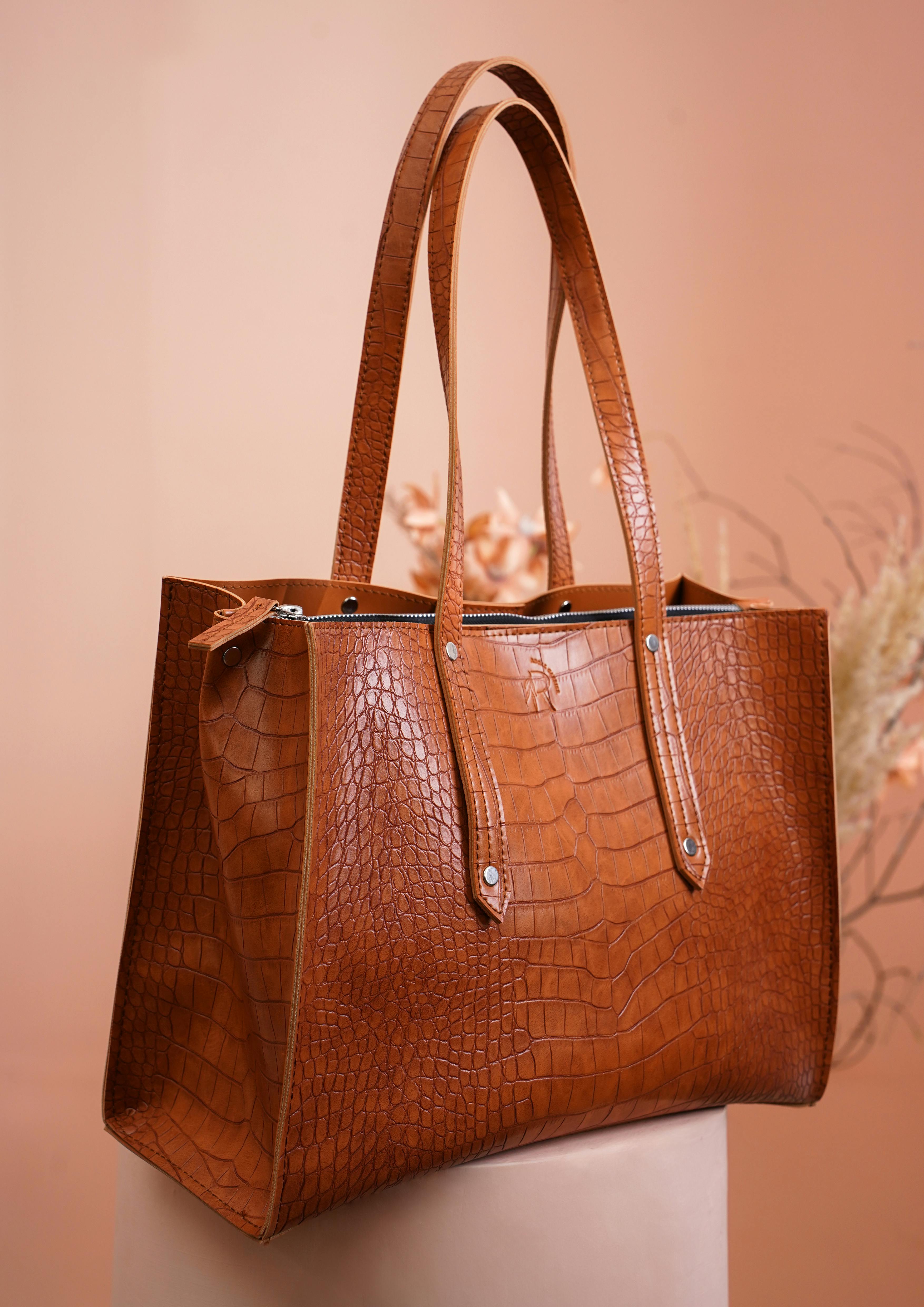
Weight and softness arrive together on authentic hide at this level, and faking both at once is difficult. Held under a lamp, genuine leather absorbs it rather than bouncing it back in a sheen. The grain ought to read as natural and irregular rather than marching along in a uniform repeat, and with no unnatural cracking. Fake leather comes across stiff, thin or faintly plasticky, and reflects light in a way that reads as coated. Where the bag is suede, the colour should be uniform with no plastic sheen, since both patchiness and shine are tells. Because the camera flattens this quality, touch beats sight on this one.
4. Both Stamps, and How to Read Them
Genuine bags carry two marks, deliberately understated. The exterior stamp is small and placed low on the side, melting into the leather rather than announcing itself. Look inside for a crisp, centred stamp carrying the logo and the words Made in Italy — wording that appears on the brand’s own product pages for the Half Moon, Soft Margaux 10 and 12, Margaux Shoulder 12, Bourse Clutch, Terrasse To-Go and Large Slouchy Banana. Misaligned letters, smudged edges, uneven depth or an off-centre stamp are all red flags. Because the design language avoids it, any oversized or prominent exterior mark is wrong on principle. Assess how well the impression is struck, not simply that it exists.
5. Weigh and Work the Hardware
Expect palladium-plated fittings with a matte or brushed finish, never mirror-bright. Weight should read as solid, not hollow, with smooth edges and no casting seams. Work any closure several times: the action should be precise and consistent rather than loose or gritty. Buckles and base feet are engraved on the Margaux, and how well that engraving is cut makes a useful close-up test. Because the Soft Margaux family carries protective metal feet and an interior toggle closure, a listing showing neither should prompt questions. Shiny, light or crudely finished fittings disqualify a row handbags listing on their own.
6. Structure: Does It Hold Its Shape
Structure is what good construction produces and fakes seldom manage to reproduce it. A real bag holds shape with nothing in it, and it recovers its form once it has been carried. Take everything out, stand it on a flat surface and view it from the side rather than from above. A slump, collapsed corners or a base that refuses to sit flat all point to thinner leather. Compare dimensions with published figures where those exist: the Soft Margaux 10 is listed at 10 x 7 x 7.5 inches with a five-inch handle drop. The Half Moon needs care here, where the official 8 x 13.5 x 2.5 inches does not agree with figures published elsewhere, so read a small discrepancy as inconclusive.
7. Price It Model by Model, Not Brand-Wide
Price checks hold up, but only model by model, never across the whole brand. A major resale authenticator places new Margaux bags in the $5,000 to $9,000 range, and the Margaux 15 has been reported reselling around $4,350 to $6,000 and above in early 2026, so a listing in the hundreds is almost certainly counterfeit. The same logic does not extend to the entire line, because observed 2026 prices include genuine catalogue pieces at $590 for the Double Travel Wallet, $900 for the Boone Tote and $1,390 for the Half Moon. Check the model name too, since counterfeit sellers make up names the label has never used. The Park family stops at the N/S Park Tote, Park Tote, Park Tote Three, XL Park Tote and N/S Park Crossbody. Reports in 2025 widely described the Margaux as pulled from third-party retailers, though the brand has never officially confirmed it, which only raises the stakes on it.
Packaging Is Corroboration, Never Proof
Examine the dust bag and box by all means, but never let them carry the decision alone. Expect a branded ribbon stitched into one bottom corner of an authentic dust bag, a care card as standard, and centred box logos with even spacing. Counterfeiters replicate packaging far more readily than edge paint, and packaging is easy to source separately and pair with a fake bag. Treat correct packaging as one supporting signal and incorrect packaging as a reason to look harder at the bag. Treat receipts and screenshots with the same scepticism, because faking them takes almost no effort. Should the bag fail checks one through six, no dust bag will save it.
The Check in Order
Because in-hand inspection is the only reliable method, where you buy matters as much as what you check. Purchase new from the brand’s own boutiques or from established stockists such as Bergdorf Goodman, Neiman Marcus, Net-a-Porter, Mytheresa or Selfridges and the question disappears. On resale, in-hand authentication is what lowers the risk, which is why Rebag, The RealReal, Fashionphile and Vestiaire Collective sit below open marketplaces. On Poshmark and eBay the burden falls on you, since counterfeit reporting flags both as higher-risk venues for this label. Below is the sequence to run before you pay for anything. The table that follows sets out what each checkpoint looks like passing and failing.
- Check that the model name is real and price-check it against that model, not the brand
- Examine stitching density and edge paint in close-up images or in hand
- Test the hand, grain and light response of the leather or suede
- Identify both stamps and grade the interior one for crispness and centring
- Test hardware weight, finish and closure action, plus Margaux engraving
- Empty the bag, then check that it stands and holds its shape
- Use packaging as corroboration and nothing more, and purchase through a source that authenticates in hand
| Checkpoint | Passes if | Reads wrong when |
|---|---|---|
| Seams and stitching | Even density, no fraying | Drifting stitch lines, threads working loose |
| Painted edges | Even coverage, nothing spilling over | Bubbles or thin patches |
| Calf leather | Substantial yet soft, absorbs light | Throws light back, feels stiff, thin or faintly plasticky |
| Suede finish | Even colour, matte throughout | A plastic sheen, or colour in patches |
| Exterior stamp | Low on the side and small | Large, high, or visually prominent |
| Interior stamp | Crisp, centred, logo plus Made in Italy | Smudged, misaligned or off-centre |
| Metal fittings | Weighty, matte or brushed, moving precisely | Shiny and lightweight, with a rough or gritty action |
| Shape | Stands with nothing in it and recovers its form | Collapsed corners, a slump, an uneven base |

